XP-512D / XP-513D
XP-512D and XP-513D heavy duty wheel balancers
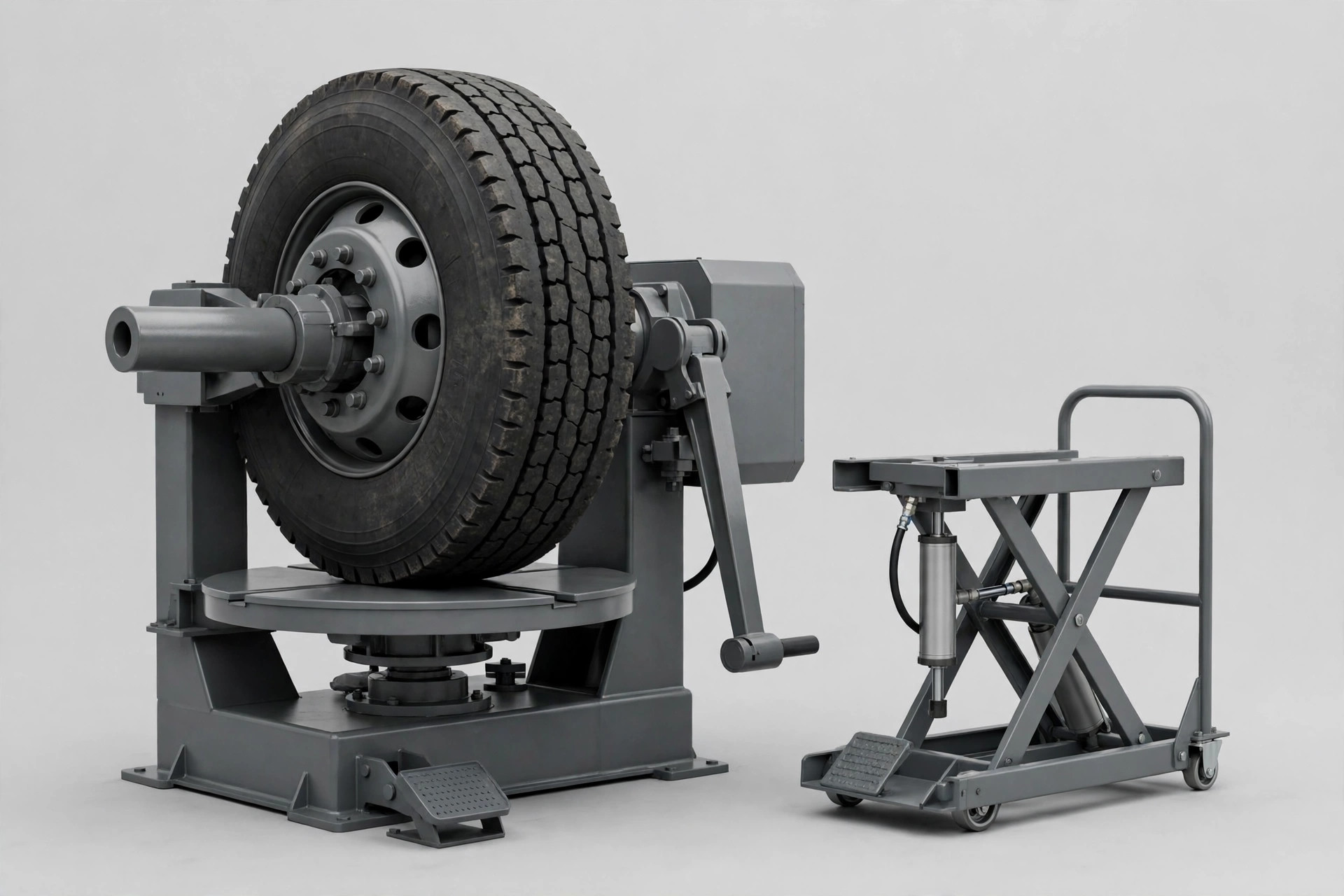
The XP-512D and XP-513D are the truck balancer family's headline pair: identical published working figures — wheels to 1,200 mm, rims 10–28 inches, ±10 g precision at 180 rpm — differing in build weight, for fleets balancing truck wheels daily.
Request a quotationBrowse the range- Wheels to 1,200 mm
- Rims 10–28 in
- Precision ±10 g
- Power 0.55 kW
Truck balancing, in truck tolerances
±10 g is not a worse ±1 g; it is the correct tolerance language at truck scale, where the rotating assembly may weigh two hundred kilograms and the correction weights are measured in tens of grams. Both models run a 10-second cycle at 180 rpm on a 0.55 kW motor, over wheels to 1,200 mm diameter, rims 10–28 inches and widths 3–20 inches — the envelope of mainstream truck and bus work.
The two models are published with the same working figures and different weights (200 and 217 kg net), which is to say: ask for the choice between them to be confirmed in writing at quote stage as configuration and build detail, not a capability step. Start the confirmation conversation from the figures themselves.
Mounting is the repeatability story
A truck balancer's results stand or fall on how the wheel sits on the shaft: centre-hole cones for the common forms, flange arrangements for hub-piloted wheels, and a shaft and drive that do not deflect under the assembly. The family's lift-equipped siblings (the XP-512 and XP-598) make the mounting physical work easier; on this pair, the wheel handling arrangement for your heaviest assemblies is a quote-stage item to settle explicitly.
Fleet buyers should also settle the record habit: the before/after figures a fleet manager files are the balancer's commercial output as much as the balanced wheel is. Ask how results are displayed and printed for the exact configuration quoted.
XP-512D and XP-513D specification
The parameters below. Both models: voltage 220/380V; power 0.55 kW; balance cycle 10 s; balance speed 180 rpm; precision ±10 g; max wheel diameter 1,200 mm; rim diameter 10–28 in; rim width 3–20 in.
| Parameter | XP-512D | XP-513D |
|---|---|---|
| Net weight | 200 kg | 217 kg |
| Gross weight | 233 kg | 242 kg |
| Packing size | 1,220 × 970 × 1,100 mm | 1,220 × 970 × 1,250 mm |
Checks before a heavy-duty balancer quote
- Your heaviest assembly and largest diameter against the 1,200 mm envelope.
- Mounting forms in your fleet: centre-hole sizes and hub-piloted arrangements.
- Wheel handling: how assemblies reach the shaft, and whether a lift-equipped model suits better.
- Three-phase or single-phase supply at the balancer position.
- The configuration distinction between the two models, confirmed in writing.
Questions buyers ask about heavy duty wheel balancer
512D or 513D?
On published working figures they are the same machine; the distinction is build and configuration detail. Ask for it in writing for the unit quoted, and let the answer and the price make the choice.
Why is there no wheel-weight figure?
This pair is specified by diameter and rim envelope rather than a wheel-weight rating. Your heaviest assembly is therefore a confirmation to obtain for the exact configuration — ask it by name in the inquiry.
Can they balance the steer axle to car standards?
Truck balancing works in truck tolerances for sound physical reasons; a steer wheel balanced to ±10 g on a true mounting is correct work. Chasing car-gram figures on a 200 kg assembly is display-reading, not engineering.
Send an inquiry
Ask for the unit matched to your work. Send the model code you are considering and the work it will do each week; ask for that model's specification sheet in return.
Request a quotation About the company