Car benches
Car benches for auto body repair
Collision repair starts with a bench: the car is clamped, measured against fixed reference points, and pulled back into shape with 100 kN of hydraulic force. The family is two benches — the XP-601 and the XP-600 — sharing one pulling standard.
Request a quotationBrowse the range- 5,600 mm benches
- 100 kN pulling capacity
- 360° pulling radius
- Loads to 3,500 kg
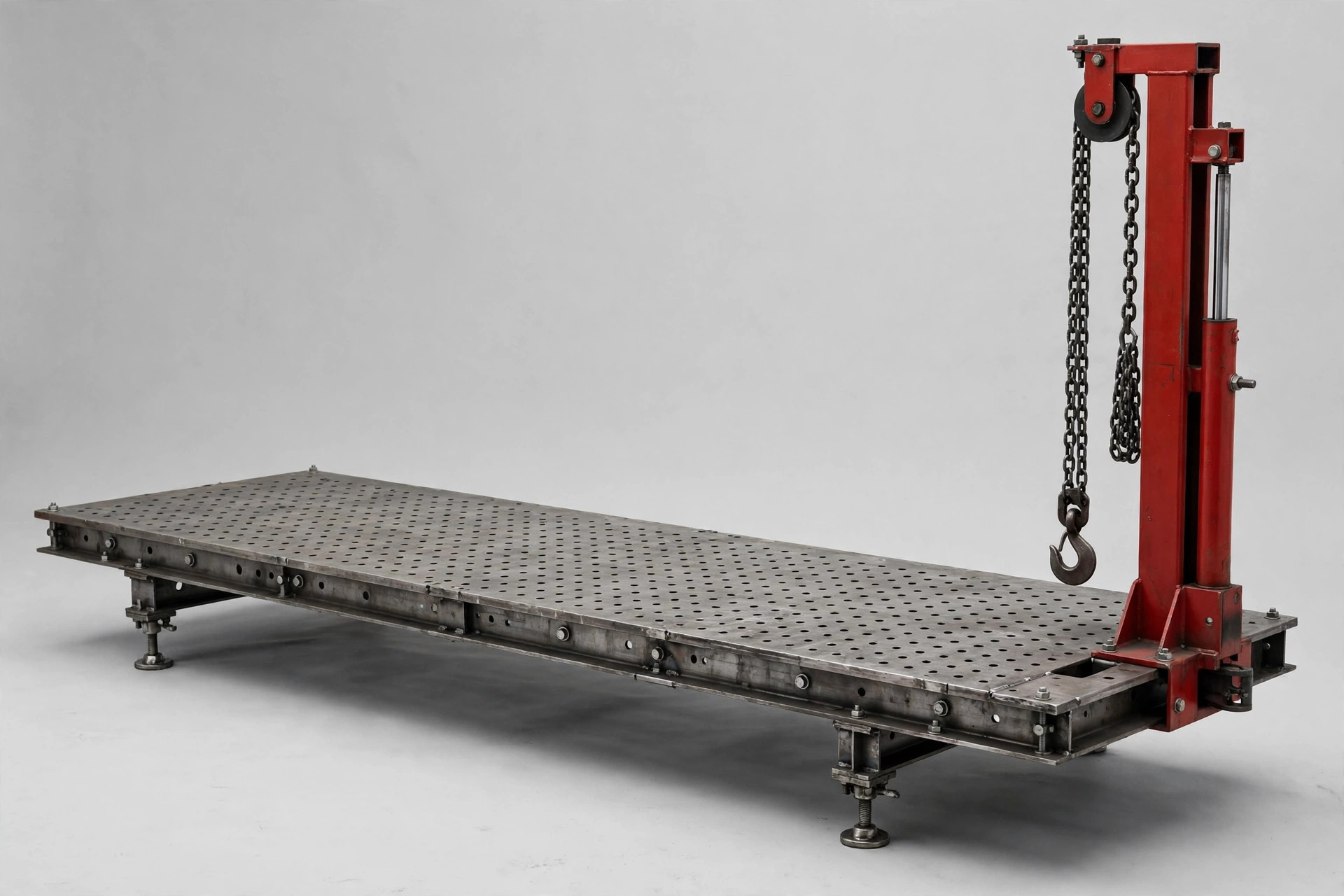
The bench is the reference, not just a platform
A car bench does three jobs: it holds the damaged car rigidly by its clamps, it gives the repair a fixed set of reference points to measure against, and it fixes the pulling equipment that walks the structure back into place. Shops that do structural work cannot substitute a lift for any of the three. Both benches in this family run a 5,600 mm platform at 2,200 mm wide, pull at 100 kN through a 360° radius on 70 Mpa hydraulics, and differ in height arrangement and maximum load.
Bench work is also a workflow purchase: the bench occupies its bay for the length of a structural job, so the buying conversation is about your collision volume and the measuring method your technicians are trained in as much as about the machine. Compare both benches side by side on the family's one detail page: that comparison is the one a body shop actually makes.
Bench pages in this family
Generic illustration of an auto body frame bench with a pulling tower and chain
Car frame straightening machine
The XP-601 and XP-600 benches tabulated: 100 kN pulling, 360° radius, loads to 3,500 kg.
View the pageThe two benches at a glance
Both benches share the pulling standard; they divide on height arrangement and load.
| Item | What it is / how it is handled |
|---|---|
| XP-601 | 5,600 × 2,200 mm bench at 560 mm height; maximum load 3,500 kg. |
| XP-600 | 5,600 or 6,000 mm length; height adjusts 350–1,150 mm; maximum load 3,000 kg. |
| Pulling | 100 kN capacity through a full 360° radius, on 70 Mpa hydraulic power, both models. |
| Air supply | 0.8 Mpa air supply required for the clamping and auxiliary systems, both models. |
| Measuring | Ask for the measuring arrangement your shop works to at quote stage. |
Checks before a bench quote
- Your vehicle mix: the longest and heaviest cars you straighten.
- The measuring method your technicians are trained for, and any data your work requires.
- Bay length for the bench plus the pulling room around the full radius.
- Floor fixing or pit requirements for the installation you choose.
- Collision volume: the bench's bay is committed for each structural job's duration.
Questions buyers ask about car benches
XP-600 or XP-601?
The XP-601 carries the heavier load rating on a fixed-height bench; the XP-600 trades some capacity for a height-adjustable platform over two lengths. Straightening volume and the cars you take decide; compare both side by side on the detail page and judge the trade between them directly.
What measuring comes with it?
Ask for the measuring arrangement to be confirmed per order against the way your shop works; raise it in the inquiry with your current method named, and ask for the quote to answer the real question.
Bench or a lift with a pulling frame?
For cosmetic and light work, lesser arrangements cope; for structural repair the bench's clamping and reference points are the job. If your work includes structural pulls, the bench is not the upgrade — it is the tool.
Send an inquiry
Ask for the unit matched to your work. Send the model code you are considering and the work it will do each week; ask for that model's specification sheet in return.
Request a quotation About the company