Full-rise scissor
Full-rise automotive scissor lifts
The XP-8435, XP-8435S and XP-8440 are the full-rise scissor group: twin platforms lifting to 2,100 mm, at 3,500 kg for the 8435 pair and 4,000 kg for the 8440, for workshops that want platform lifting without posts at the bay's corners.
Request a quotationBrowse the range- Lift height 2,100 mm
- 3,500–4,000 kg
- Platform 1,540 × 550 mm
- Motor 2.2–3.0 kW
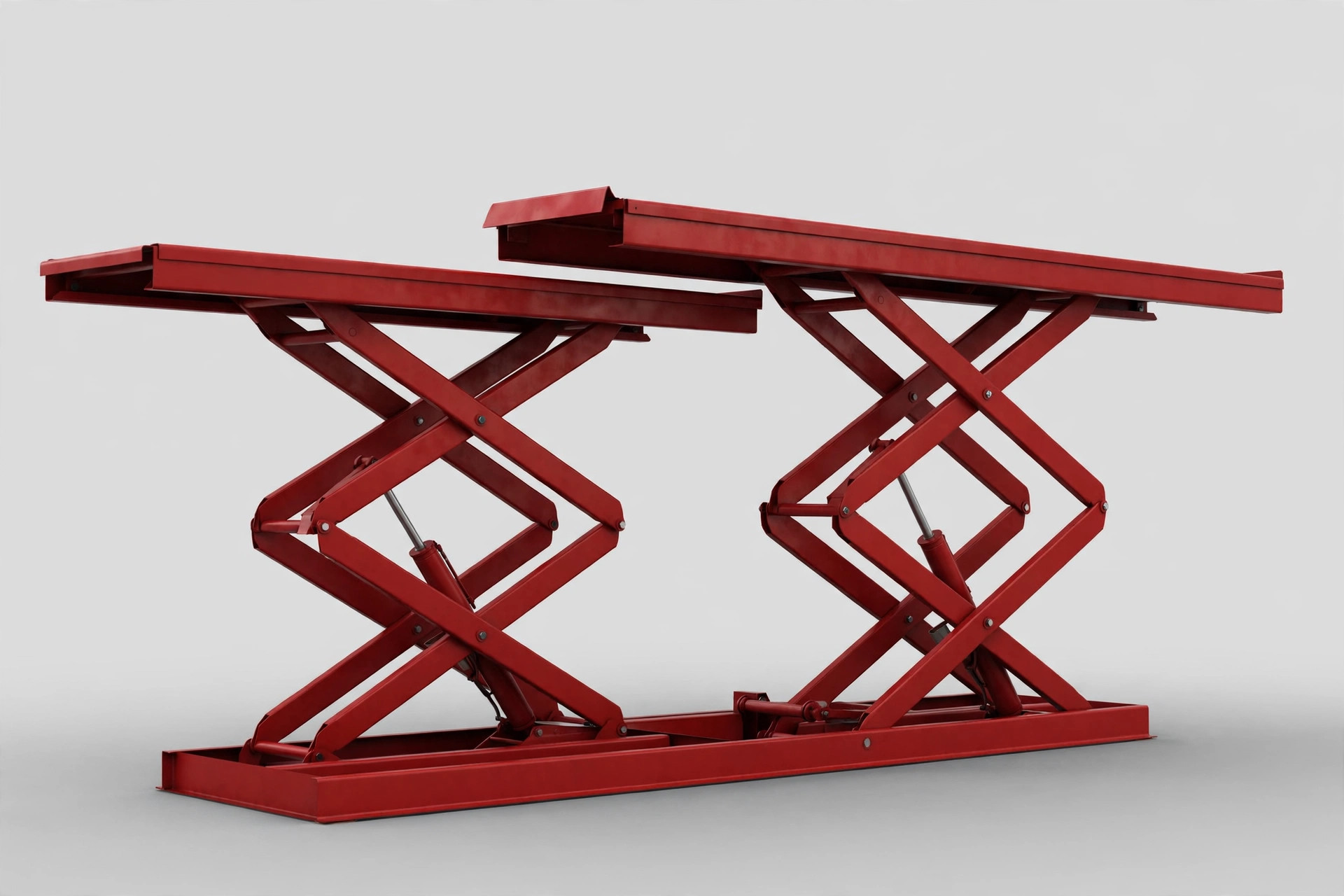
Platform lifting, standing height
A full-rise scissor takes the car on twin platforms and rises level to 2,100 mm — full standing height underneath, with no posts interrupting the bay's sides and nothing to position but the car itself. The work it suits is the underbody middle ground: exhausts, inspections, transmission-adjacent jobs and detailing, in bays where a two-post's arm work is slower than the job deserves or where the floor cannot take post fixings in the right places.
The group's platform is compact — 1,540 mm long by 550 mm per side — because the mechanism lifts at the sills and wheels' inner span rather than carrying the full car on runways. That compactness is the form's charm in a tight bay and its limit with long-wheelbase vehicles; the platform positions and block arrangements for your vehicle mix are a quote-stage conversation, with your longest car named.
The three models against each other
XP-8435 and XP-8435S are the same lift in published figures — 3,500 kg, 2,100 mm, 2.2 kW — differing in machine weight (800 against 820 kg) and in the configuration detail the S suffix carries — ask for that detail per model at quote stage. The XP-8440 steps to 4,000 kg and a 3.0 kW motor at the same platform size and height, and at 850 kg is the group's heaviest machine.
All three share the family's working figures: 340 mm minimum height, 70–90 second lifting time, 0.6–0.8 Mpa air supply for the locks and 24 Mpa rated oil pressure. The 340 mm minimum height is the figure to interrogate: it is higher than the sill height of low cars, so drive-on approach and block practice for your lowest vehicles belong in the inquiry, not in the first week's surprises.
Full-rise scissor specification
The full-rise group's parameters are in the table below.
| Model | Capacity (kg) | Lift height (mm) | Min height (mm) | Platform (mm) | Motor (kW) | Weight (kg) |
|---|---|---|---|---|---|---|
| XP-8435 | 3,500 | 2,100 | 340 | 1,540 × 550 | 2.2 | 800 |
| XP-8435S | 3,500 | 2,100 | 340 | 1,540 × 550 | 2.2 | 820 |
| XP-8440 | 4,000 | 2,100 | 340 | 1,540 × 550 | 3.0 | 850 |
All three models: lifting time 70–90 s; air pressure 0.6–0.8 Mpa; rated oil pressure 24 Mpa; motor supply 380V three-phase or 220V single-phase.
Checks before a full-rise scissor quote
- Your lowest car's sill and clearance against the 340 mm minimum height and approach practice.
- Longest vehicle's lifting-point span against the 1,540 mm platform.
- Floor condition under the base frames, and whether the bay stays drive-through when lowered.
- Air supply for the locking system at the lift's position.
- What distinguishes the S configuration, confirmed in writing if it is quoted to you.
Questions buyers ask about automotive scissor lift
Scissor or two-post at the same money?
Two-post for engine-out and gearbox work with full underbody access; full-rise scissor for platform convenience, level lifting and bays where posts do not fit the workflow. Workshops that do both kinds of work usually end up owning both forms.
Can it lift vans?
The XP-8440's 4,000 kg covers car-derived vans by weight; the platform span decides by lifting points. Name the van in the inquiry and have the fit confirmed against the platform drawing.
Is 70–90 seconds slow?
It is platform pace. Across a day it is minutes; across the same day a two-post's arm positioning costs similar time in the other direction. Judge it against your job mix, not against a stopwatch.
Send an inquiry
Ask for the unit matched to your work. Send the model code you are considering and the work it will do each week; ask for that model's specification sheet in return.
Request a quotation About the company