Guide
Transmission jack buying guide
A transmission jack carries the gearbox out from under the car and — harder — offers it back up square to the engine. This guide covers the two jack architectures, the saddle's real job, and how to judge capacity without a salesman's help.
Request a quotationBrowse the range- Two architectures compared
- Saddle articulation explained
- Capacity judged by gearbox
- A method guide, no model numbers
Start here
Gearbox work concentrates a workshop's risks into one object: a heavy, awkward, oil-filled casting that must come down level, travel across the floor, and go back up aligned to a few millimetres, all while a technician's hands are near it. The jack that does this is not a lifting accessory; it is the tool the whole job is built around.
This guide treats the transmission jack as a product type. It gives you the architecture choice, the saddle questions and the capacity method to apply to any unit quoted to you, from any source.
Low-position and upright telescopic jacks
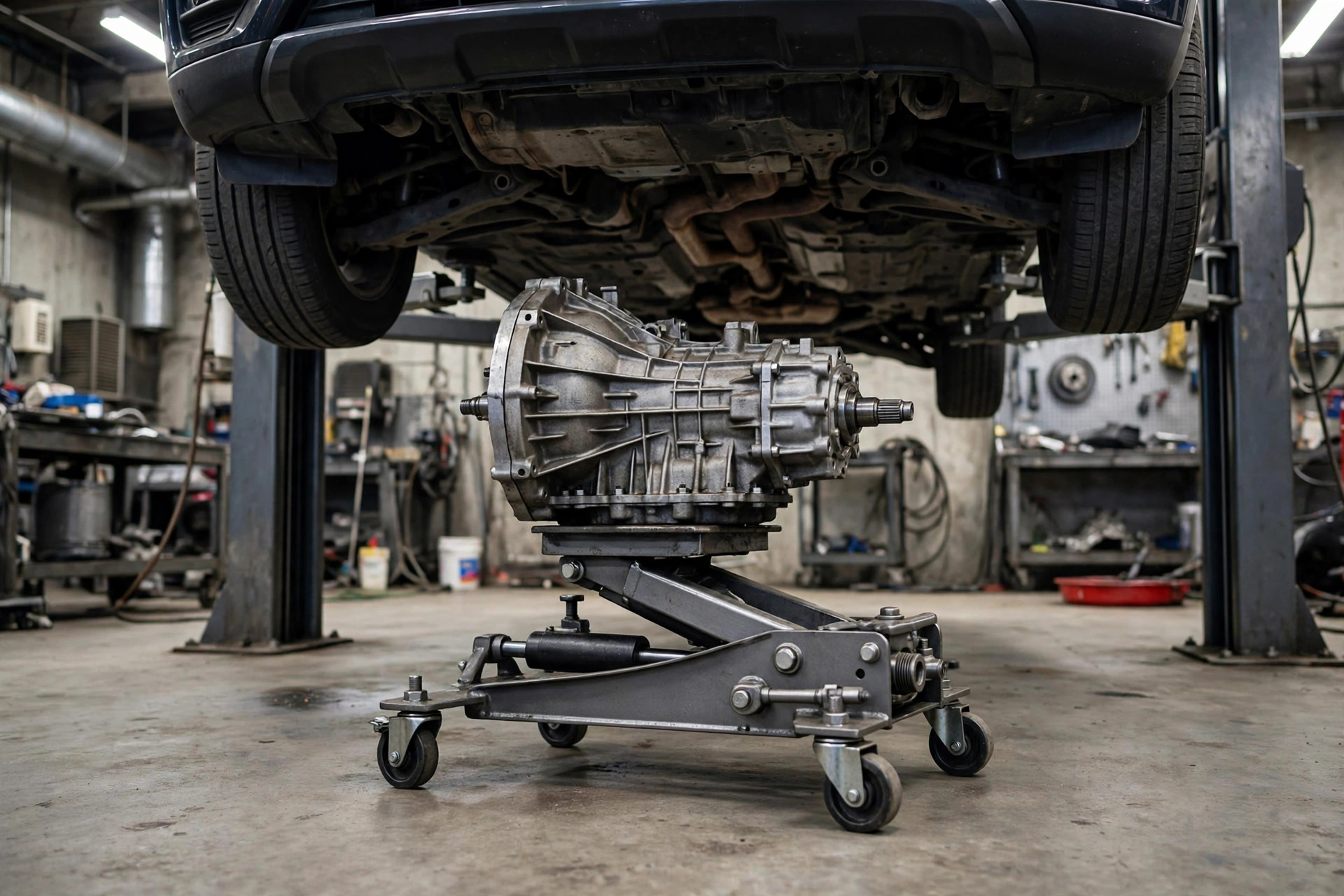
A low-position transmission jack works like a floor jack with a transmission saddle: it rolls under the raised car at low height and lifts the gearbox the short distance off its mounts. It suits work where the car is on a two-post lift at moderate height and the gearbox comes down to the floor. An upright telescopic jack stands under a car at full lift height and reaches up to the gearbox on a vertical ram, in one or two stages; it is the tool for high-lift work and for engines and subframes as well as gearboxes.
The choice is your lift heights. A workshop whose gearboxes come out under full-height lifts belongs on the telescopic type; a low-lift or pit operation belongs on the low-position type. Buying the wrong architecture is not corrected by capacity.
The saddle does the alignment
Anyone can lift a gearbox; the jack earns its price on the way back up. The saddle must tilt — fore-aft and side-to-side — so the gearbox's bell housing can be offered square to the engine while the jack takes the weight, and it must hold that tilt under load without creeping. Chains or straps secure the unit to the saddle for the travel across the floor.
When you assess a jack, work the saddle adjustments through their full travel and ask how the tilt is locked. A saddle that adjusts freely and locks vaguely is worse than a simpler saddle that locks solidly, because the failure arrives at the worst moment: input shaft half-engaged, hands committed.
Judging capacity honestly
Rate the jack against the heaviest gearbox-and-engine work you actually do, with the assembly complete — torque converter, fluids, transfer box where it comes out as one. Modern automatic and electrified drivetrains have moved gearbox weights up; a rating chosen from memory of lighter work is the classic under-purchase.
Capacity interacts with height on telescopic jacks: ask for the capacity at full extension, not only at the base of the stroke, and for the minimum saddle height against your lowest lift working position. Those two figures, not the headline rating, describe the jack you will use.
Wheels, footprint and the travel test
The loaded jack travels: from under the car to the bench or the stand, across floor joints and drain covers. Caster size and the footprint's stability under an offset load decide whether that travel is a push or a negotiation. A wide, stable base with large casters is worth more than catalogue refinements you cannot feel.
Apply the travel test in imagination to any quoted unit: your heaviest gearbox, on the saddle, crossing your floor's worst ten metres. If the picture worries you, the jack is wrong regardless of its other figures.
Transmission jack types at a glance
| Item | What it is / how it is handled |
|---|---|
| Low-position jack | Floor-jack architecture; works at low and moderate lift heights; comes down to the floor with the box. |
| Upright telescopic | Vertical ram to full lift height; one or two stages; also serves engines and subframes. |
| Saddle | Tilt in two planes, positive locking, securing chains — the alignment tool. |
| Capacity | Judge at full extension against your heaviest complete assembly. |
| Mobility | Caster size and footprint decide loaded travel across real floors. |
Questions buyers ask about transmission jack guide
Can a transmission jack lift the whole car?
No — it is a component jack for gearboxes and similar assemblies under an already-lifted car. Vehicle lifting belongs to the lift families.
One-stage or two-stage telescopic?
Two stages reach lower minimum heights for the same maximum, which matters when the car is at moderate lift. Ask for both end figures and match them to your lift's working heights.
Do I need a tilting saddle for manual gearboxes too?
Yes — alignment on refit is the saddle's job for every gearbox type. Manual boxes are lighter, which makes the tilt easier to control, not unnecessary.
Send an inquiry
Work the guide on your own facts first. Take the measurements and counts the guide sets out on your own vehicles and floor; then send the results with the family you are asking about.
Request a quotation About the company