Comparison
Manual vs automatic tire changer
Manual changing means bars, a bead breaker and the operator's strength; automatic means a powered turntable machine that clamps, breaks, mounts and inflates. This page compares the two on the work itself — and places the catalogue's swing-arm families honestly between them.
Request a quotationBrowse the range- Labour per wheel compared
- Rim-damage risk compared
- Stiff-tyre reality
- Volume break-even method
Two ways to get a tyre off a rim
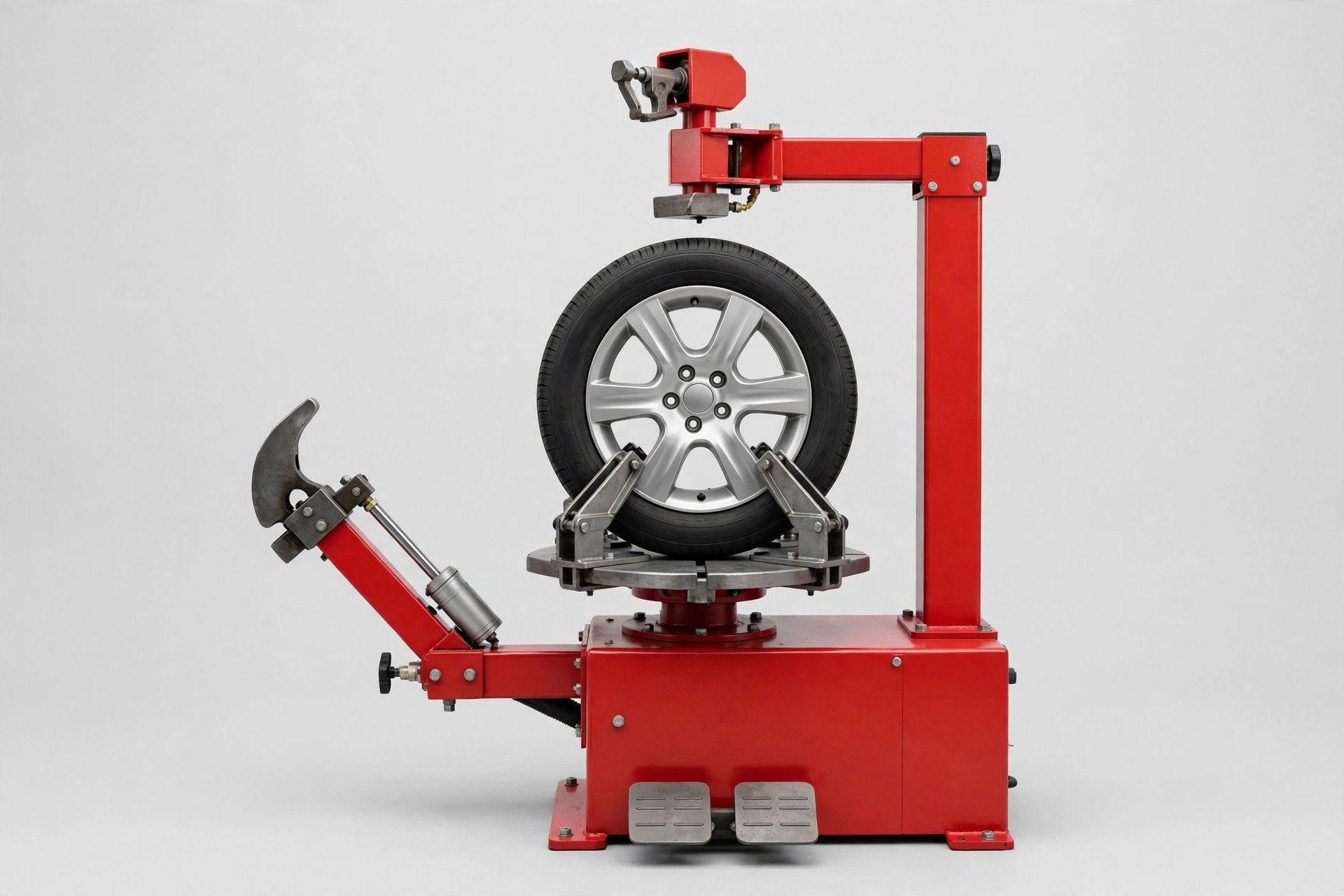
Manual changing is a skill, not a machine category: a bead-breaking tool, tyre levers, a mounting paste and a practiced operator. It costs almost nothing to equip and a great deal to staff, and its quality lives entirely in the operator's hands. At the other end, an automatic changer — in common usage, a powered machine with a tilting column and pneumatic assistance throughout — clamps the wheel, breaks both beads, and walks the tyre off and on under power, with the operator guiding rather than forcing.
Between those poles sit the semi-automatic swing-arm machines that make up most of this catalogue's changer families (the XP-316 and XP-326 lines): powered turntable and bead breaker, with the arm swung and locked by hand. This comparison keeps all three honest: manual, semi-automatic and automatic are points on one line of labour substitution, and the right point is set by your wheel count and your tyre mix.
Manual, semi-automatic and automatic, compared
| Point | Manual changing | Powered changers (semi-auto and automatic) |
|---|---|---|
| Equipment cost | Bars, breaker and paste — the cheapest entry in tyre work | A machine purchase; swing-arm below tilt-back automatic in price |
| Labour per wheel | Highest, and it rises steeply with tyre stiffness | Lowest on automatics; swing-arm machines close behind on ordinary tyres |
| Run-flat and low-profile | Possible for experts; slow, with the highest rim-risk in the trade | Helper-arm work: controlled, repeatable, the bead held in the drop centre |
| Rim damage risk | Lives in the operator's technique, wheel by wheel | Lives in setup and jaw protection — consistent once set |
| Throughput | One skilled operator, a handful of wheels an hour at best | The bay's clock: changer cycle times measured in minutes per wheel |
| Skill dependence | Total — the method is the operator | Shared — the machine carries the force, the operator carries the judgement |
| Best fit | Emergency, field and very low volume work | Any workshop whose tyre work is a service it sells |
Where manual changing still wins
Honesty requires the manual case. For a handful of wheels a week, for field and motorsport work where the machine cannot go, and for the emergency that arrives when the machine is down, bars and a breaker are rational equipment. Manual skill is also the trade's foundation: an operator who has changed tyres by hand understands beads, drop centres and rim danger in a way that makes them better on any machine.
What manual changing cannot do is scale, or treat stiff modern fitments kindly at volume. The modern car parc — low profiles, run-flats, large diameters — is precisely the work manual method handles worst, and it is an increasing share of every workshop's tyre book.
Where the automatic premium pays
Tilt-back automatics over swing-arm machines buy repeatability of setup: the column returns to its settings, bead breaking and mounting happen at pedal pace, and the helper arm is integrated rather than added. The premium pays where the same sizes repeat all day and where stiff fitments are the norm — fleet and performance work — because the saved minutes and saved rims are daily, not occasional.
The break-even method is unglamorous arithmetic: wheels per week, times minutes saved per wheel, times your labour rate, against the price step. Add one damaged alloy rim a quarter to the manual side of the ledger if your mix is stiff — most workshops that do this sum honestly stop arguing with it.
Questions buyers ask about manual vs automatic tire changer
Is a swing-arm machine 'automatic'?
In the trade's loose language, powered changers are often all called automatic; strictly, the swing-arm families are semi-automatic (the arm is positioned by hand) and the tilt-back machines automatic. This page uses the strict senses, because the difference is what the price step buys.
Can a manual operator match a machine on ordinary tyres?
On easy tyres, a master is not far behind on one wheel. Across a day of mixed work — and on the stiff minority — the machine's consistency is the product. Workshops sell consistency.
What is the first powered machine to buy?
For most car workshops, a swing-arm machine from the XP-316A or XP-326 class, with a helper arm if stiff fitments are weekly. Take the clamping tables from the changer pages to finish the choice.
Send an inquiry
Compare both sides against your own work. Put your wheel sizes, vehicle weights and changeover counts side by side; ask for each side priced on its own written confirmation.
Request a quotation About the company