Paint booths
Portable paint booths: the honest case for inflatable
'Portable' in paint booths means the inflatable family: a full-size cabin that inflates for work and packs away. This guide makes the case for it, states its limits without flinching, and draws the line where panel booths take over.
Request a quotationBrowse the range- Cabin 6,900 × 3,900 mm
- Fan sets to 25,000 m³/h
- Power 16.5–17 kW
- Limits stated plainly
Start here
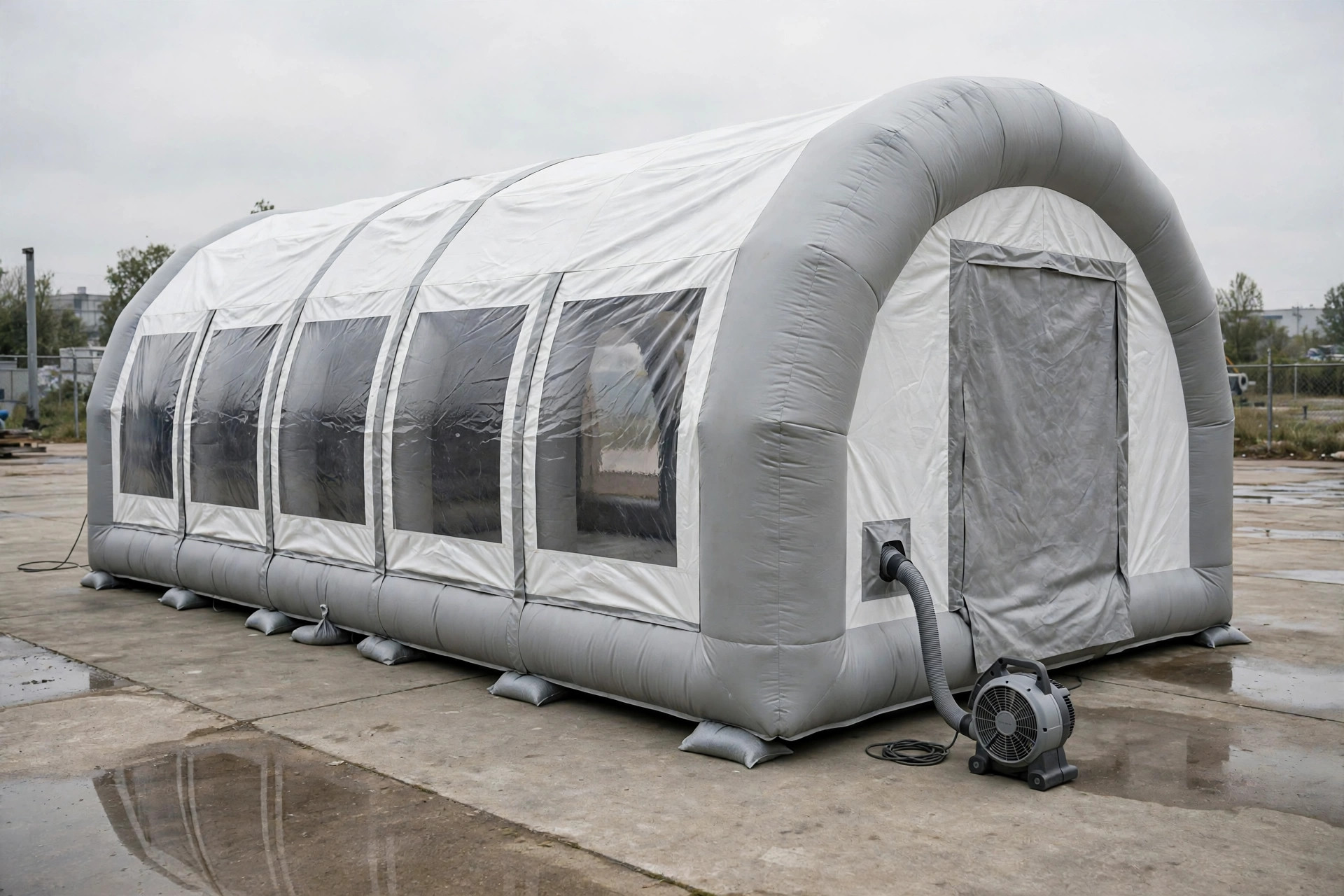
The portable paint booth is usually sold as a compromise, which undersells and oversells it at once. The inflatable family in this catalogue — XP-614, XP-615, XP-616 and XP-618 — works a cabin of 6,900 × 3,900 mm, the same footprint as the panel booths, with fan sets up to 25,000 m³/h. That is not a toy pretending to be a booth; it is a booth whose building is air.
This guide takes the format seriously in both directions: what it genuinely does well, what it cannot do, and how to choose inside the family by the only figures that matter — the fans.
What inflatable actually buys
Three things, none of them small. First, permission: no construction, no landlord negotiation over a built cabin, no building permit saga in many jurisdictions — the booth is equipment, not a structure. Second, time: it works the week it arrives. Third, reversibility: the site can be vacated, the booth moved or stored, and the business is not married to a cabin it built in the wrong place.
For mobile refinishing, seasonal overflow, start-up body shops and rented premises, those three are not conveniences; they are the difference between offering paint work and not offering it. Judge the format against that counterfactual, not against a permanent booth in a building you own.
The fan sets are the specification
Strip the format away and a booth is moving air: the four models divide exactly there. XP-614: intake 25,000 m³/h from two 4 kW fans, exhaust 15,000 from a 7.5 kW unit, 16.5 kW total. XP-615: balanced 18,000 m³/h each way at 17 kW. XP-616: intake-led again at 25,000 in and 18,000 out. XP-618: turbo fans both ways at 25,000 m³/h, 17 kW, in the tallest cabin of the family at 2,800 mm internal height.
Choose by air behaviour for your paint process and by where the exhaust can go — even a portable booth exhausts somewhere, and the route is a site fact. Intake-led sets suit positive-pressure working; balanced sets suit processes that want neutral behaviour. The painter who will work in it should have a voice in this choice disproportionate to their seniority.
The limits, stated plainly
An inflatable booth is not a bake oven, not a permanent installation's equal in insulation or in decades-long durability, and not a structure that forgives careless handling, storage or repair neglect. Its envelope is a working component that lives with fans running and ages with use. Daily production painting at volume wears it as the main tool rather than the flexible one, and that duty belongs to the panel booths (the XP-612 and XP-613 in this catalogue).
Climate is the other limit: uninsulated air structures follow the weather more than panel cabins do, and paint processes have temperature opinions. A workshop painting through hard winters in an unheated shed should cost the heating question before it costs the booth.
The boundary, drawn
The decision reduces to duty pattern and site tenure. Painting in bursts, on sites you do not control, with a business still proving its paint volume: inflatable, sized by its fans. Painting daily, on a site you hold, with finish quality as your market promise: panel, and treat the inflatable as the overflow answer it also legitimately is.
Many mature shops end with both — panel for production, inflatable for the overflow and the odd large job — which tells you the formats are complements at scale and alternatives only at the start. Buy for the stage you are at, with the next stage's answer visible in the same catalogue.
Before you order one
Walk the site checks the model page lists: the inflated footprint with its ground fixing, total power of 16.5–17 kW on the models that state it (the XP-614, XP-615 and XP-618, on a three-phase supply) at the working position, the exhaust route, and storage for the packed structure. Add one of your own: the repair route for the envelope — material, patches, and who does them — asked in the inquiry, because a portable booth's life is its handler's discipline.
Then choose the fan set with your painter, state the site's facts, and ask for the model to be confirmed in the quotation. Portable is a serious format bought the same disciplined way as everything else in this catalogue.
The second season: storage, reuse and the jobs between
A portable booth is bought for a season of work and kept for years of it, so judge the folded life as carefully as the working one. Where will it store, in what footprint, and who can move it there? A booth that stores badly gets stored badly — left half-erected in a corner, gathering the dust it exists to exclude, until the day it is needed and found damaged.
Count the jobs between the big ones, too. The booth that only earns on full resprays may sit folded through the bumper and panel work that a slightly larger working envelope would have admitted. Match the booth's working size to the whole queue, not to the largest job of the year, and its cost spreads across far more invoices than the purchase was justified on.
Storage discipline has a technique of its own: clean before folding, dry before sealing, and the blower and filters stored where they will be found with the booth rather than in the general pile. Ten minutes at the end of a job is the whole cost; the return is a booth that erects next season in the condition it left this one.
Questions buyers ask about portable paint booth guide
How long does an inflatable booth take to put up?
Inflation is the fans' work and is quick; the full working setup — positioning, fixing, filtration and ducting the exhaust — is the real task and should be planned as a setup routine, not a moment. Ask for the setup sequence for the exact model in your inquiry.
Can it be used outdoors?
It can work on suitable ground in suitable conditions, with ground fixing and weather judgement; it is not an all-weather building. Most workshops run them inside large sheds, where the format's no-construction advantage is undiluted.
Is finish quality worse than a panel booth?
Finish follows air behaviour and painter discipline more than wall material. The panel booth's advantages are permanence, insulation and bake options — real, but different from a claim that inflatable air cannot produce good work.
Send an inquiry
Read the method, then measure your own workshop. Work through the article's checks on your vehicles and your floor; send the results with the family and model you are asking about.
Request a quotation About the company