Home lifts
Home garage lift guide: buy for the garage you have
Home lift advice usually starts with the lift. This guide starts with your garage — its ceiling, its slab, its door tracks and your mornings — and only then admits four candidate machines, each with its published figures.
Request a quotationBrowse the range- Garage-first method
- Four home-suitable models
- Slab verification stressed
- Storage vs work split
Start here
The home garage is the harshest lift environment there is — not mechanically, but dimensionally. Ceilings carry door tracks and openers, slabs were poured to a house builder's specification nobody recorded, and the 'workshop' must return two cars to the road every morning. Professional lift advice assumes none of that, which is why home buyers need their own guide.
Four machines in this catalogue genuinely suit homes: the XP-1527 single-post, the XP-7640 four-post platform, the XP-1127 parking system and the XP-8228 mid-rise scissor. This article qualifies each against the garage facts, and answers the two-post question that every home buyer asks.
Measure first: the four numbers
Ceiling height to the lowest obstruction — track, opener, beam — not to the plaster. Door opening height and the car's approach angle. Slab facts as far as they can be known: age, visible cracking, any record of thickness. And the cars: heights, weights and the leaving order of a normal week. Those four sets of numbers are the entire home lift decision; everything else is shopping.
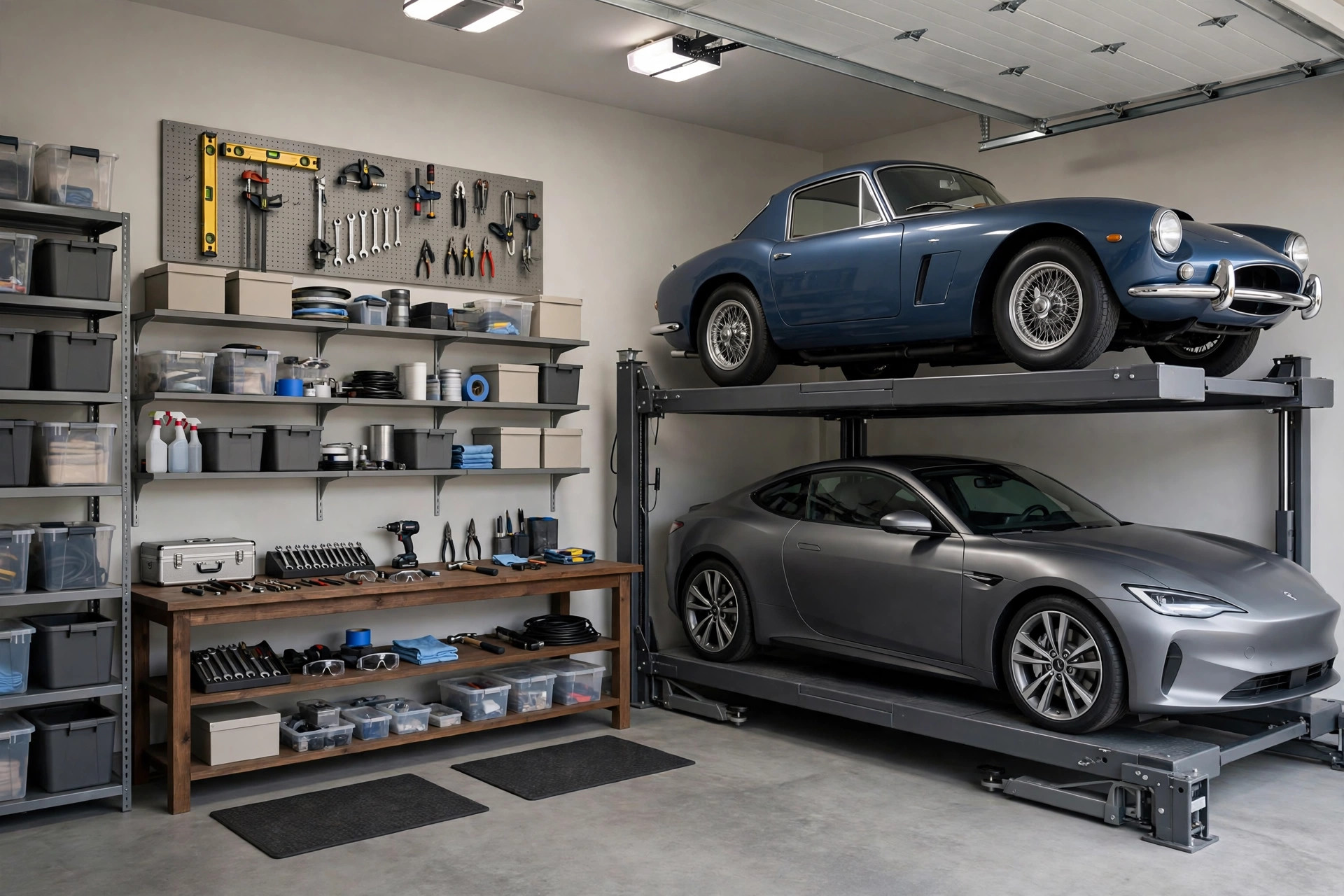
Storage candidates consume the numbers arithmetically. Take the XP-1127's accepted car envelope from its own page. The XP-7640's platform rises 1,700 mm, under which the lower car's roofline must fit while the upper car's meets the ceiling. Working candidates consume them differently: the XP-1527 stands 2,550 mm tall and lifts its car 1,800 mm, so the car's roof at full height is your ceiling sum.
The slab: the question that decides bolted-down lifts
Bolted-down machines — four-post platforms included — put their loads into your concrete at discrete feet. House slabs vary enormously, and the only respectable procedure is the model's installation requirements in writing, checked against your slab by someone qualified to judge it, before the order. Skipping that step is how home lift projects become home renovation projects.
The movable-base XP-1527 and the base-framed XP-8228 spread their loads and avoid bolt fixings, which is a large part of their home popularity. Spread load is not no load: cracked, thin or hollow-sounding slabs rule out machinery until assessed, whatever the base.
Storage or work: the honest split
Decide what the machine is for before comparing models, because the candidates barely overlap. Storage: the XP-1127 (stacked parking in a single slot) or the XP-7640 (storage platform that also lifts for light work). Work: the XP-1527 (full-height working lift that moves) or the XP-8228 (wheel-height work station that stores flat). A buyer who wants both should weight the XP-7640 carefully — it is the catalogue's genuine hybrid.
The leaving-order test disciplines the storage choice: the car that leaves first must be the accessible one, every morning, including the mornings the routine breaks. Households that run the test honestly sometimes discover they need working lift plus ordinary parking, not storage machinery at all.
The two-post question
Every home buyer asks it, because the two-post is the iconic lift. The honest answer: a two-post lift at home requires a verified slab for its bolt fixings, ceiling for its frame (or acceptance of the floor plate), and a genuine underbody-work hobby to justify both. Garages that meet all three exist and their owners are happy. Garages that meet two usually end up happier with one of this article's four.
There is also a low-ceiling member of the family — the low-frame XP-7132, the family's lighter model — for homes whose ceiling is the binding fact and whose work is cars only. Take its figures and its confirmation list from its page, and read them with this article's slab discipline in mind.
Power, delivery and the last checks
Home power is the quiet constraint: the models here publish 220V single-phase motor options alongside 380V three-phase, and the single-phase version is normally the home order — confirm the version in the inquiry rather than discovering the alternative on delivery day. Delivery itself deserves a thought: these are 450–1,200 kg machines arriving at a house, and access for the truck and the unload belongs in the order conversation.
Close with the routine rehearsal: walk the car's path in, the lift's operation, the second car's path under or out, and the walk to the house door, in imagination, on your measured floor. If the rehearsal flows, the garage and the lift fit each other — which was the purchase all along.
The removal question nobody asks at purchase
Home lifts are sometimes sold on, moved house with, or taken out when the garage changes use — and the forms divide sharply on how kindly they leave. A bolted post lift unbolts; the slab keeps its fixing holes, which fill in an afternoon. A parking platform's posts leave the same modest evidence. What does not leave kindly is any system that needed the floor cut, pits dug or structure altered to install.
Ask the removal question while you are still choosing, especially in a house you may sell: what does this machine need from the building permanently, and what does it hand back? The answer rarely changes which form suits the work, but it prices the decision honestly — a lift that returns the garage untouched is worth something at resale that no capacity figure captures.
Measure the garage once, honestly, and keep the numbers with the house documents. The next owner, the next car or the next machine all inherit the same ceiling and slab, and the household that knows its own measurements answers every future equipment question in minutes instead of weekends.
Questions buyers ask about home garage lift guide
Which home lift adds the most resale value?
The one the next owner's garage also fits — which argues for the movable and less building-committed options in most homes. Treat resale as a tiebreaker, never the reason: you are buying years of your own use.
Can a home lift run on a normal domestic supply?
The single-phase versions of these models are designed for it, subject to the circuit's capacity for the motor. An electrician's check of the intended circuit is part of the slab-and-ceiling discipline, and cheap at inquiry stage.
Is a parking system practical for daily use?
Yes, with the routine organised once: the accessible car is the first car out. Ask for the XP-1127's cycle figures in writing at order stage, and judge the routine against the confirmed numbers, not against a guess.
Send an inquiry
Read the method, then measure your own workshop. Work through the article's checks on your vehicles and your floor; send the results with the family and model you are asking about.
Request a quotation About the company