Portable air
Portable air compressors: choosing mobile air
Portable means two different things in this catalogue: diesel machines that carry air to sites with no supply, and belt-driven piston machines that move around a workshop's own floor. This page separates the two and sizes each honestly.
Request a quotationBrowse the range- Diesel line XP-35–XP-220A/B
- Code models XP-0.9/12.5 up
- Belt-driven movables
- Selection by site and duty
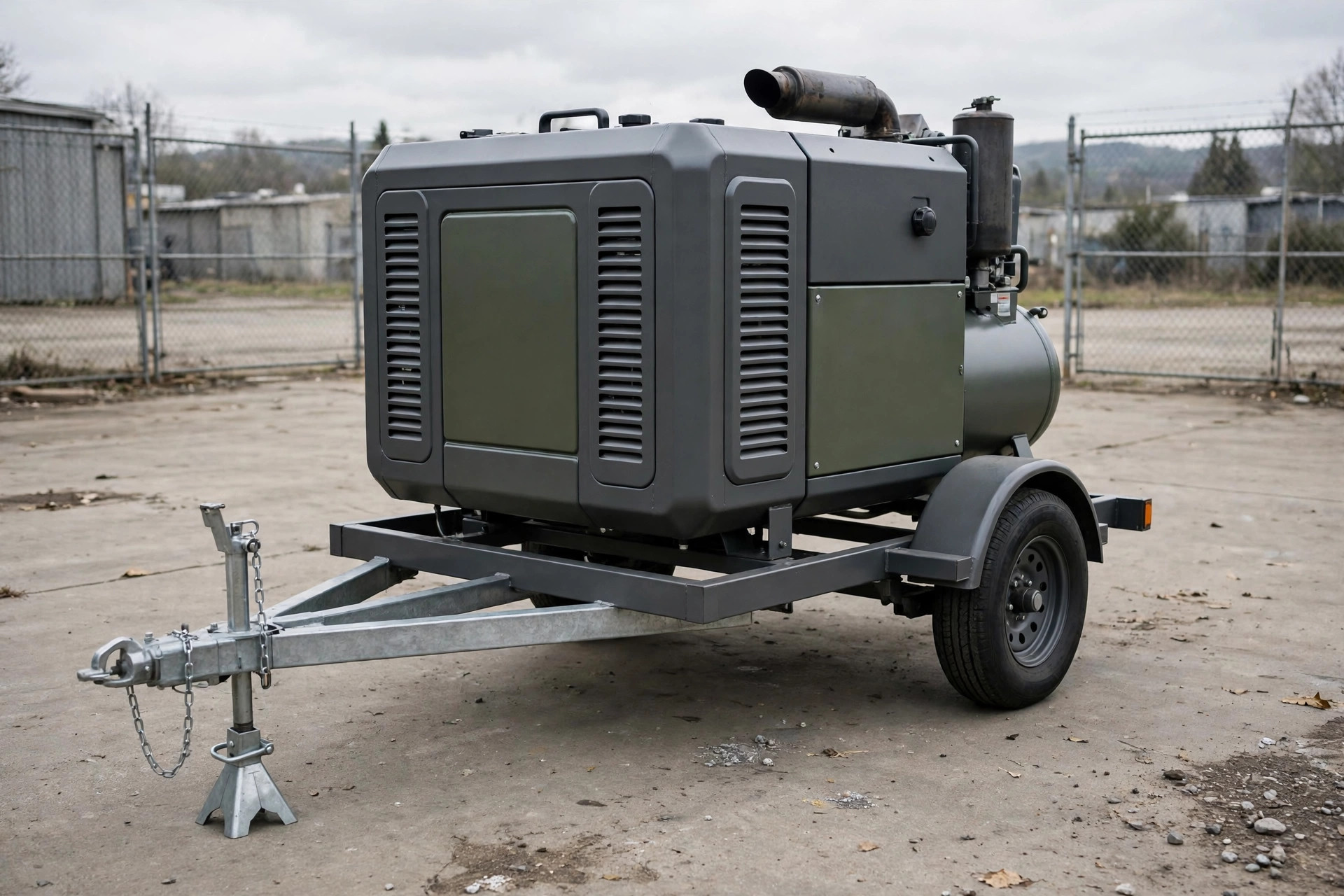
Two kinds of portable
A diesel portable is a power station that makes air: engine, compressor and towing gear in one unit, indifferent to buildings. A movable belt-driven piston machine is a workshop compressor on a tank with wheels or a carry frame: it still needs the building's electricity, and its portability is measured in metres, not miles. Confusing the two is the family's classic buying error, and it usually starts with a search term.
For diesel, work from the code-designated XP-0.9/12.5, XP-1.0/14 and XP-1.05/14 up to the numbered XP-35 through XP-220A/B line. For belt-driven portables, work from XP2070-8 to XP2.0/8. Either way, ask for each model's figures from its per-model sheet. Decide between them on the points below, and on the cases where neither portable answer is right.
The decision, by where the air works
Air needed off-site, on yards, fronts and fields: diesel, sized from the site tools' demand at the hose end. Air needed at several points inside one building with power everywhere: a movable piston machine can serve a small operation, but a fixed screw or piston with a proper ring main usually serves it better and quieter — portability inside a building is often a pipework problem wearing a compressor's clothes.
Air needed at one fixed point with bursty demand: not portable at all — the belt-driven page's fixed installation. The portable premium, in either drive, buys mobility; spend it only where mobility is the actual requirement, and state that requirement in the inquiry, and ask for the quotation to be built around it.
The portable ranges at a glance
Both portable ranges, complete. Take the full lists from the model pages, and keep the drive-type distinction exact.
| Range | Models | Portability |
|---|---|---|
| Diesel, code-designated | XP-0.9/12.5, XP-1.0/14, XP-1.05/14 | Towed or stationed on site; no supply needed |
| Diesel, numbered line | XP-35, XP-50, XP-70, XP-90, XP-120, XP-120A/B, XP-220A/B | The site machines |
| Belt-driven movable | From the XP2070-8 to XP2.0/8 list | Moved within the building; needs its power supply |
Checks before a portable quote
- Where the air works each week — sites, yards, or points inside one building.
- Demand at the hose end: tools, pressure and simultaneous use.
- Towing vehicle and coupling for diesel units; floor routes for movable pistons.
- Noise and exhaust placement wherever the unit will run.
- Exact model identity in the quotation, drive type named.
Questions buyers ask about portable air compressor
Can one diesel portable serve two sites?
Sequentially, yes — that is its purpose. Simultaneously, no: a portable's mobility is time-shared, and two sites that both need air at 9 a.m. need two answers, one of which may be a fixed machine.
Is a movable piston a site compressor?
No — it needs mains power and workshop conditions. Sites without supply are diesel ground, whatever the piston machine's wheels suggest.
How do I size a portable?
From the tool list at the hose end, with hose losses counted on long runs. Bring the list to the inquiry; the guide page works the same arithmetic in full.
Send an inquiry
Work the guide on your own facts first. Take the measurements and counts the guide sets out on your own vehicles and floor; then send the results with the family you are asking about.
Request a quotation About the company