Truck tyre work
Semi truck tire changer: sizing from the fleet list
Truck changers are bought wrong when they are bought from the average wheel. This guide sizes from the fleet list instead — largest wheel, widest tyre, heaviest assembly — and maps the result onto the range's three capacity groups.
Request a quotationBrowse the range- Fleet-list method
- Rim groups 14–26 / 14–42 / 14–48 in
- Wheels to 2,000 kg
- Bead force 2,500–3,300 kg
Start here
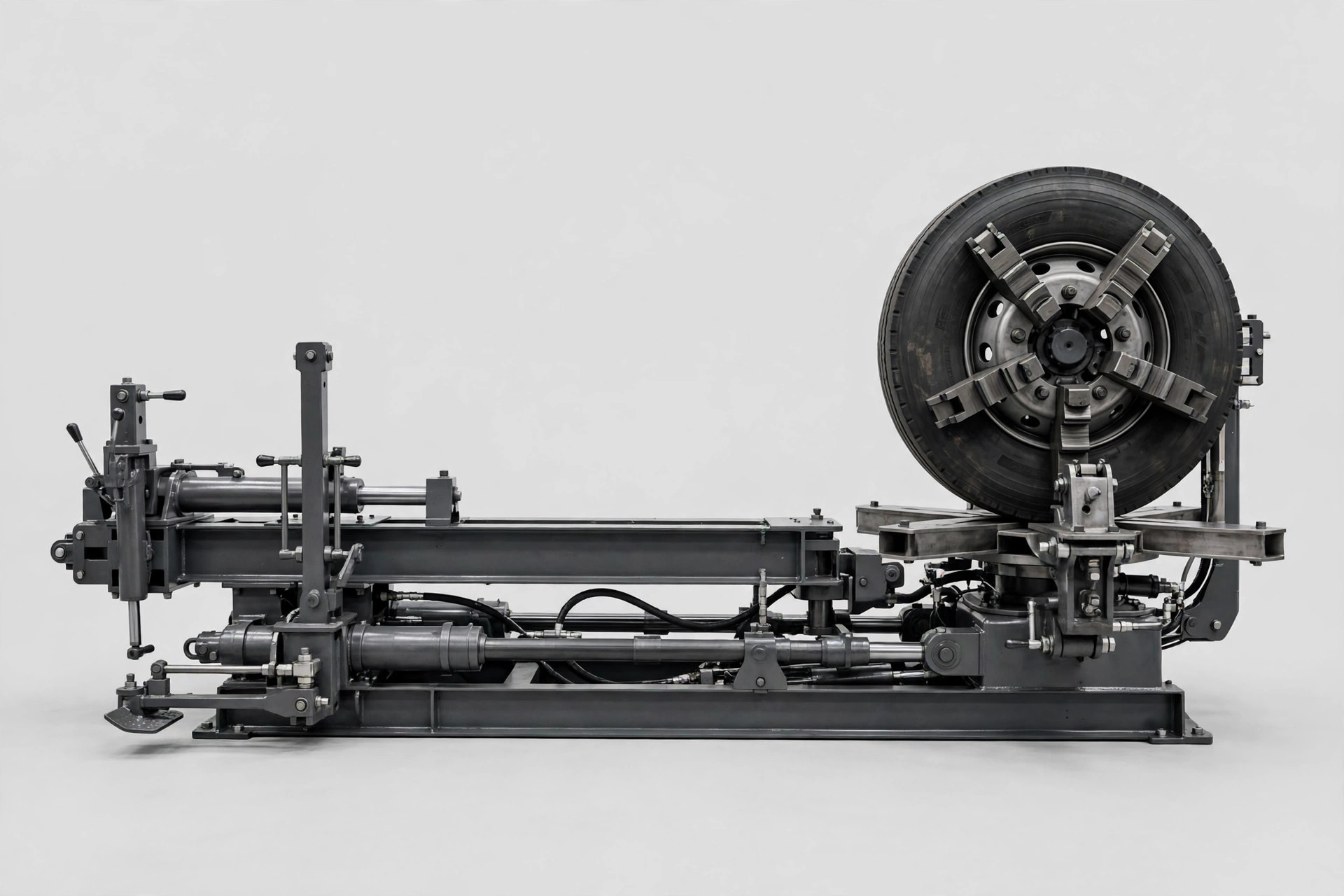
A semi truck tire changer is a safety machine disguised as a productivity machine. The work it replaces — bars, hammers and a technician's back under a 100-plus-kilo assembly — is where tyre bays get hurt, and the machine's economics only start after that argument is won. Sizing it is nonetheless an engineering exercise, and it starts with a document most workshops have never written: the fleet list.
This guide writes the list, reads the three sizing variables off it, and maps them to the truck changer groups in this catalogue: XP-468, XP-498 (with the XP-402 and XP-498D), and the heavy-duty XP-499 pair.
The fleet list: three lines that size the machine
Line one: rim diameters, smallest to largest, with the frequency of each — the changer's chuck range must cover the envelope, and frequency tells you where the machine will live its life. Line two: tyre widths and diameters at the top end — the XP-468 group takes tyres to 1,600 mm diameter and 780 mm wide; the XP-498 group to 2,300 mm and 1,050 mm; the heavy-duty pair to 2,600 mm and 1,400 mm. Line three: the heaviest wheel-and-tyre assembly, because wheel weight is a chuck and drive figure: 500 kg, 1,600 kg and 2,000 kg across the same three groups.
Write the list from the fleet's records or a week of bay notes, not from memory. Fleets always contain one vehicle nobody remembers — usually the one that sizes the machine.
Bead force and the stiff-work question
Published bead-breaker force separates the groups as clearly as rim range: 2,500 kg on the XP-468, 3,300 kg on the XP-498 group. Bead force is the machine's answer to corroded, seated-for-years beads and stiff super-single constructions; undersized force turns the machine back into a spectator while the bars come out — the exact outcome the purchase was meant to retire.
Assess your stiff-work share honestly. A fleet on a disciplined tyre programme breaks easy beads; a mixed-age fleet with outside work breaks hard ones. The force figure should be chosen for the worst bead of the month, not the average bead of the day.
Motors, torque and control
Truck changers turn assemblies with hydraulic drive and gearbox motors sized in kilowatts, where car changers use a turntable motor: 1.5/2.2 kW pairings on the XP-468 class, 2.2/2.2 on the XP-498, 3.3/4.0 on the heavy-duty pair. The working meaning is torque at the chuck under a two-tonne assembly and a carriage that travels its tools without straining.
Control voltage deserves a line in any specification comparison: the groups here run 24V pendant controls, which is the operator-safety standard for standing at a machine that can exert tonnes of force. Treat any truck changer quote without low-voltage controls as incomplete.
When heavy duty is the honest buy
The XP-499 and XP-499A exist for wheels above the standard groups: rims to 46 and 48 inches, 56 and 60 with extensions, tyres to 2,500 and 2,600 mm. Fleets with agricultural, earthmover-adjacent or unusually large fitments size there; ordinary semi fleets — 22.5-inch wheels in the main — are served by the XP-498 group with margin, and by the XP-468 group at the smaller end.
The heavy-duty error runs both ways: bought needlessly, it is a slower, larger machine for daily standard work; bought too late, the standard machine spends its life at its envelope's edge. The fleet list, again, is the referee — its top lines, not its middle, make this call.
The bay around the machine
Close the sizing with the building: the machine's footprint (the heavy-duty pair publish 2,310 × 2,100 mm outside dimensions) plus the wheel-handling room around the chuck, floor loading under a machine of 1,175 kg and up, and the staging where tyres wait. A changer that fits its envelope but not its bay is the truck version of the classic lift mistake.
Then the inquiry writes itself: fleet list attached, group chosen, chuck configuration for your rim forms to confirm, supply phase stated. Send exactly that inquiry, and ask for a specification for the exact machine in return — the only kind of quote this class of equipment should ever be bought on.
Where the machine will stand
A truck changer earns or loses its money partly on siting. It wants a working envelope with room for the largest wheel to travel from truck to turntable and back, a floor that takes the machine and the wheel together without rocking, and air and power arriving without crossing the wheel's path on hoses and cables. Walk the route with a tape before the machine ships; the drawing is cheaper than the rearrangement.
Think about the second position too: where the removed wheel waits, where the finished wheel stages, and how the next truck enters without moving either. In a busy fleet bay the changer's cycle time is rarely the bottleneck — the choreography around it is. The workshops that get the rated work out of these machines have usually solved the floor plan first, and the machine choice second.
Price the siting work into the same budget line as the machine. A slab correction, a relocated air drop or a repainted wheel route are small works beside the changer's price, and discovering them after delivery converts a planned installation into an improvised one. The fleet workshops that commission these machines in a day are the ones that walked the floor with a tape the month before.
Questions buyers ask about semi truck tire changer guide
What rim size is a standard semi truck wheel?
The mainstream semi fitment sits inside the XP-468 and XP-498 groups' ranges comfortably; the groups exist for the spread around it — smaller light-truck rims below, super-singles and special fitments above. Your fleet list tells you which group your spread needs.
Can a truck changer damage alloy truck wheels?
The chuck grips the centre hole and the tools travel under control, which is precisely the damage-avoidance design. Rim protection remains an operating discipline — correct tool positioning and lubrication — as on any changer.
Is the XP-402 different in kind?
It is a clamping-range variant in the standard family (14–27 inches, two-speed gear motor, tyres to 1,500 kg) — worth a line in the comparison if its envelope matches your list better than the 468's does.
Send an inquiry
Read the method, then measure your own workshop. Work through the article's checks on your vehicles and your floor; send the results with the family and model you are asking about.
Request a quotation About the company