Lift buying
The best 2 post car lift is a fit, not a model
Every 'best lift' list that ignores your ceiling, your slab and your vehicle mix is advertising. This article works the decision properly, using one real family — the XP-2-40 range and the models above it — as the measuring stick.
Request a quotationBrowse the range- Capacity steps 4,000–5,500 kg
- Release systems compared
- Width before weight
- Building facts first
Start here
The two-post lift is the general workshop's default machine, which is exactly why it is bought worst: everyone assumes the category is settled and skips to price. In one manufacturer's family alone the choice spans 4,000 to 5,500 kg, total widths from 3,320 to 4,500 mm, and three release systems — and each of those axes has a wrong answer for a given shop.
Decide in this order: building, vehicles, release, capacity. Work on the XP-2 family's own figures as you decide.
First axis: the building decides the form
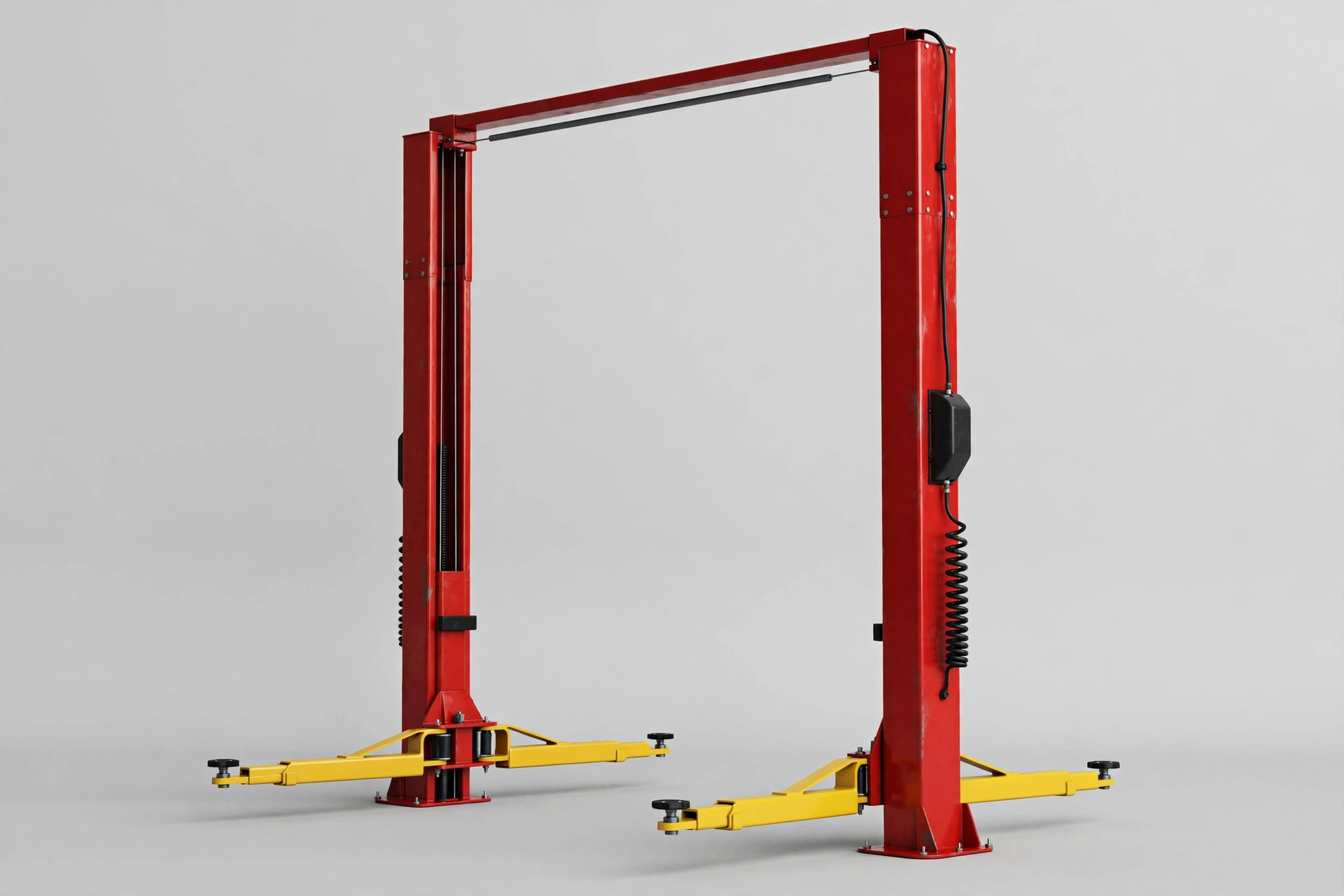
Ceiling height splits the family before anything else is discussed. Gantry (clear-floor) models need their full frame height clear, including everything your ceiling carries — lights, heaters, door tracks. Floor-plate models trade the clear floor for a lower profile. Workshops that skip this measurement buy the lift their building rejects, and the rejection is discovered by the installation crew.
Floor facts come second: two posts concentrate the whole load at two bolt patterns, so slab thickness and strength at those points are a verification, not an assumption. Both facts — ceiling and slab — are free to obtain and expensive to skip, which is why they should open your lift inquiry, every time.
Second axis: width before weight
Shops fixate on capacity and then discover the lift's real limit at the door of a wide van: pass width and door-opening room. In the XP-2 family the pass width runs 2,500 mm across the XP-2-40 core models, 2,540 on the 40L, 2,550 at the 45C and 2,555 at the 50C, and jumps to 3,055 mm on the XP-2-55C — a model that exists for width, with its capacity a consequence of its scale.
Do the width audit on your own book: the widest vehicle you lift weekly, mirrors folded, and the door swing you need at working height to actually use the lift. If standard models pass the audit, width is settled cheaply; if the widest vehicle fails it, the wide model is not an upgrade — it is the requirement.
Third axis: the release system you will feel daily
Single-side manual release (the XP-2-40A's arrangement) means one unlocking point and one walk per cycle. Two-side release (the XP-2-40) means a walk to each post. Electric release (the XP-2-40B) removes the walks. On published figures the lifts are otherwise near-identical — which is the point: this axis is pure workflow economics.
Count your cycles. A bay lifting twenty cars a day walks hundreds of metres a week to release locks; a four-car day walks almost none. The best release is the one your cycle count justifies, and neither the cheapest nor the dearest is a principle — both are arithmetic.
Fourth axis: capacity, last and least
Only now capacity — because within a sane vehicle audit it is rarely binding. The 4,000 kg core covers cars and car-derived vans; the 4,500 and 5,000 kg steps (XP-2-45C, XP-2-50C) cover panel vans and light trucks; 5,500 kg is the 55C's territory. Every model in the family lifts to the same 1,900 mm, so height does not separate them.
The capacity error to avoid is buying two steps up 'for the future'. Future vehicles are speculative; the price step, the wider frame and the heavier installation are immediate. Buy for the book you have, with one step of headroom at most.
The verdict form
The best 2 post lift, then, is a filled form: gantry or plate by ceiling; standard or wide by the width audit; release by cycle count; capacity by the heaviest weekly vehicle with one step of headroom. In this family that form lands most general workshops on an XP-2-40 model — which is not a recommendation of the model, but of the form. Any manufacturer's family can be put through the same four axes; insist on the published figures for each axis and the exercise takes an afternoon, not a leap of faith.
When the form is filled, the inquiry writes itself: model code, ceiling, slab, supply phase and the vehicle facts. Send exactly that inquiry, and ask for a written specification for the exact unit in return.
The confirmations that protect the choice
A two-post decision made on the method above can still be lost at the order stage, in the gap between the model you chose and the configuration that ships. Close it with confirmations, in writing, for the exact model code: the release system fitted, the arm configuration, the power unit's voltage and phase, and the carriage and adapter set included. Each of those has a variant somewhere in this family's tables, and a confirmation costs the seller nothing but an email.
Add the building to the same message: ceiling height at the posts, slab facts, door swing and the supply position. A seller who has your building in writing cannot later describe a misfit as a surprise, and a buyer who sent it cannot be sold a taller frame than the ceiling admits. Keep the exchange with the invoice; it is the cheapest document in the whole purchase and the one that resolves every later argument about what was agreed.
Buyers who skip the confirmation round usually discover its value at installation, when a variant difference becomes a conversation with a fitter instead of a line in an email. The confirmations also discipline the seller's own picking and packing: a model code plus four written attributes is a far harder order to fill wrongly than a model code alone.
Questions buyers ask about best 2 post car lift
Is a bigger lift always safer?
A lift used inside its rating is the safety condition; size beyond your work buys frame width and installation weight, not safety. The rated model matched to the audit is the safe purchase.
Gantry or floor-plate for a rental unit?
Floor-plate, usually: lower profile, fewer ceiling clashes you do not control. The clear floor is worth less in a building you may leave.
What if my ceiling is too low for the family?
Then the honest answers are elsewhere in the catalogue: the low-frame XP-7132, or a scissor or single-post form. A building constraint answered honestly beats a lift craned into a ceiling.
Send an inquiry
Read the method, then measure your own workshop. Work through the article's checks on your vehicles and your floor; send the results with the family and model you are asking about.
Request a quotation About the company